Afghanistan’s population has increased by a staggering 10% over the past two years.[1] The growth has been driven, in large part, by people returning from neighbouring Pakistan and Iran. The population is now estimated to be over 45 million with the majority relatively young – a staggering 63% are below the age of 25.[2] Therefore, creating jobs, particularly for young people, is one of Afghanistan’s most pressing economic challenges. What role can financial inclusion play in helping to provide employment opportunities?
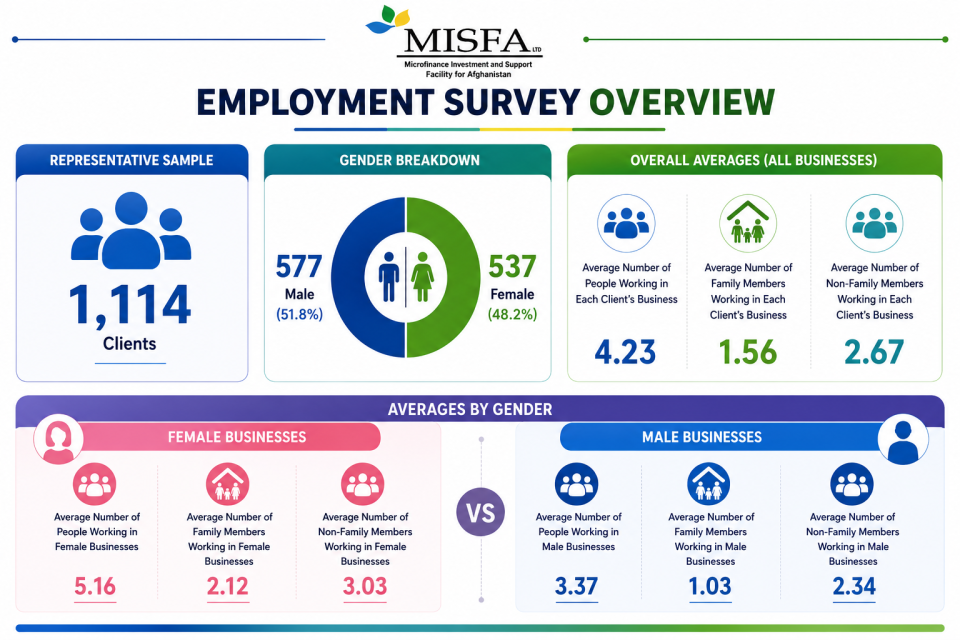
To address this question, and over a four-month period between February and May 2026, the Microfinance Investment and Support Facility for Afghanistan (MISFA) interviewed a representative sample of 1,114 clients from four Microfinance Institutions (MFIs), namely OXUS-Afghanistan, Mutahid, Momin Afghan and Shahy Khazana; and one Microfinance Bank, First Microfinance Bank – Afghanistan (FMFB-A).[3] All four institutions are regulated and licensed by Da Afghanistan Bank (DAB), the Central Bank, and between them these four institutions support almost 99% of all active clients in the microfinance sector and provide just over 91% of the total amount of sector financing.[4] The sample comprised of 537 female clients and 577 male clients. Each client had received institutional financing for the first time in the preceding six months.[5]
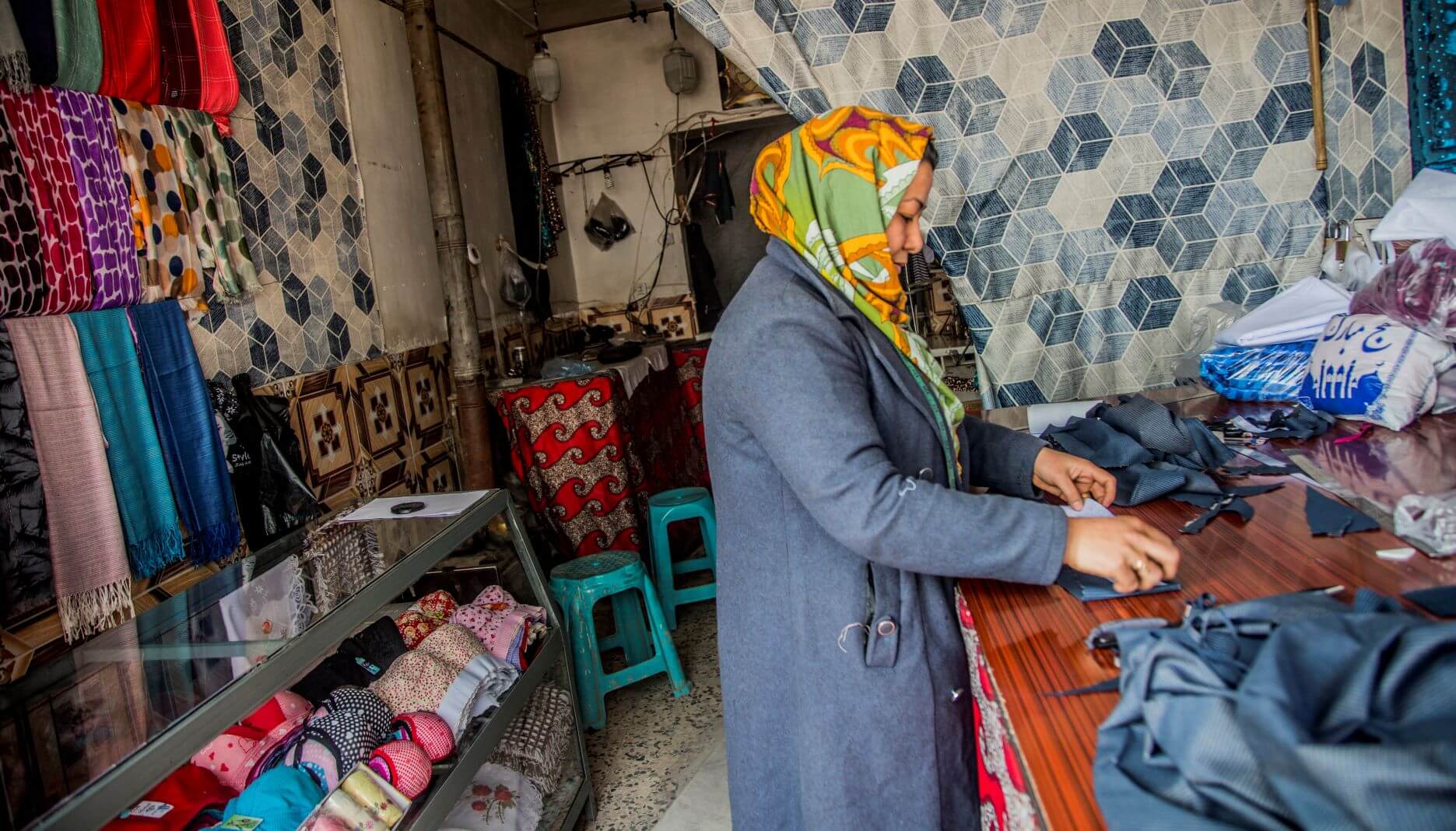
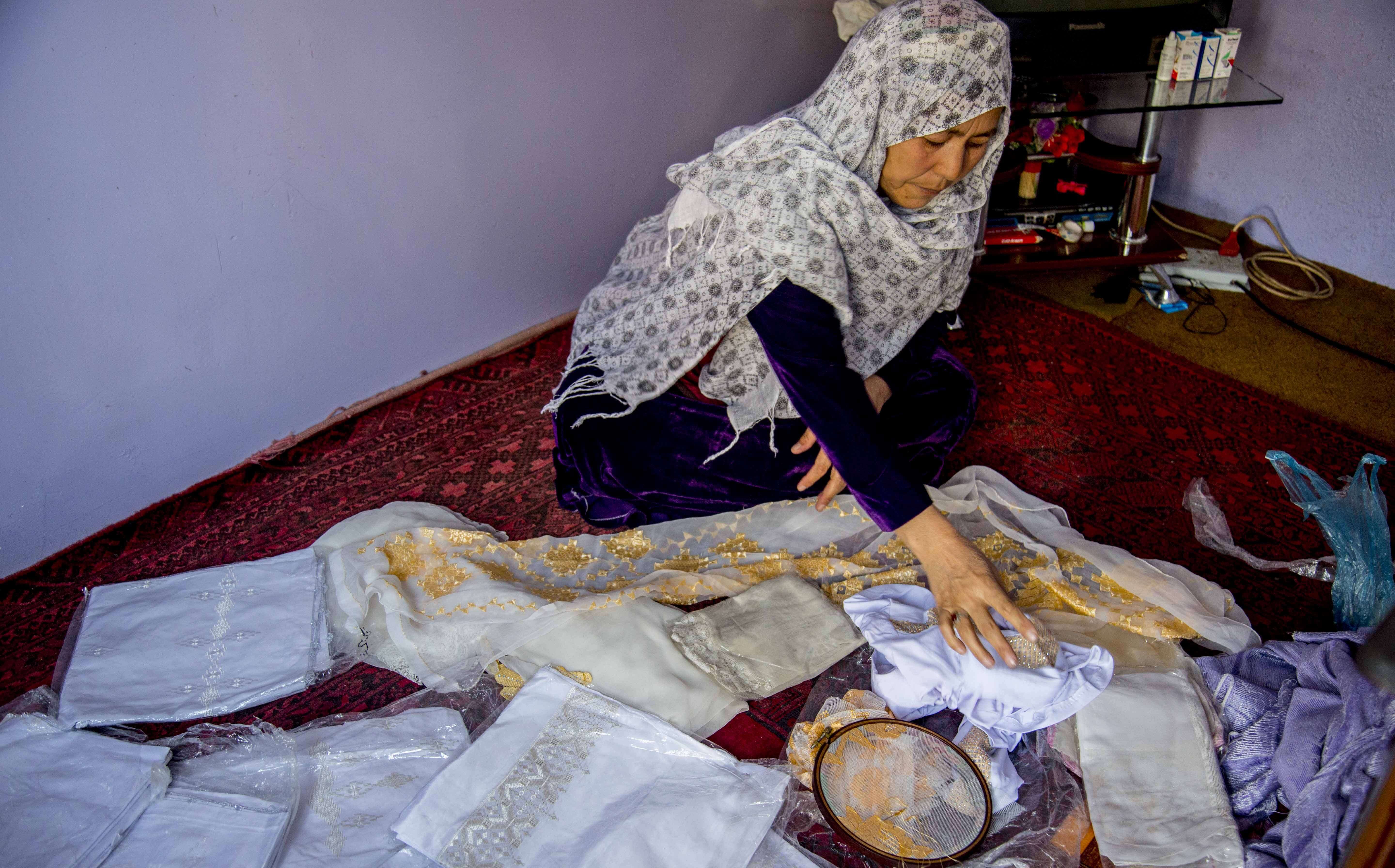
The results are both surprising and significant. The interviews revealed that, on average, each client had 4.23 people working in his or her business. Most of these workers, 2.67 on average, were non-family members, while only 1.56 were family members. Interestingly, female clients employed more people than male clients – on average women had 5.16 employees (of whom 3.03 were non-family members) in their businesses as compared to 3.37 employees (of whom 2.34 were non-family members) for men. The main reason for this was that women clients were often engaged in very labour-intensive enterprises such as tailoring and manufacturing hand-made bespoke carpets. Invariably both women and men employed people of the same gender.
As expected, our analysis reveals that clients who received larger amounts of financing employed more people.[6] Thus, clients who received of less than AFN100,000 employed 3.5 people on average; clients who received financing of between AFN101,000 and AFN300,000 employed 7.36 people; while clients who received finance of between AFN301,000 and AFN750,000 employed on average 12.82 people.[7] Clients who received the largest amounts of financing of between AFN751,000 and AFN1,500,000 on average employed 15.83 workers.[8]
Across the sector, the average financing size per client is AFN67,260 or approximately US$1,019. This is more than double the average GDP per capita which was estimated to be US$448 in 2025.[9] In effect, most of the clients supported by MFIs and banks engaged in microfinance financing in Afghanistan, might best be described as small and medium sized enterprises (SMEs), rather than microenterprises. By comparison, the average microfinance loan is much lower in other countries in the region – for example, in Pakistan it is about US$216, in India it is US$618, and in Bangladesh it is US$544.
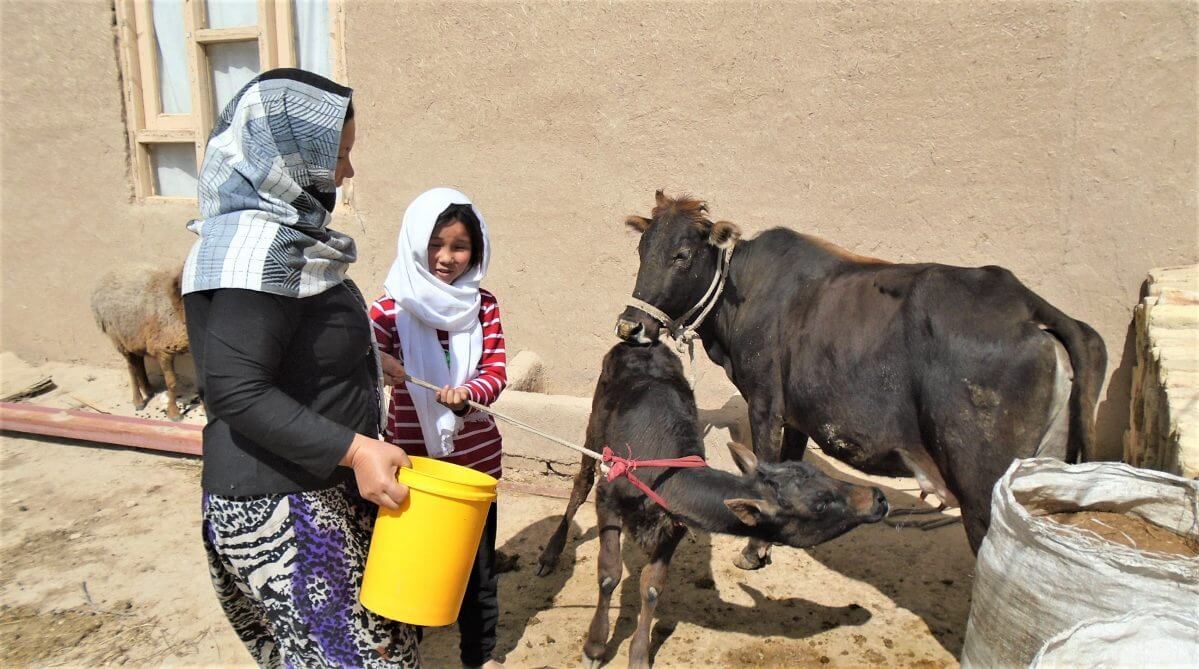
It is also apparent that the number of persons employed varies according to economic activity. Clients who received financing for agriculture and livestock employed just over 3 people on average and clients who sought financing for trade and services employed on average 4.32 people. Clients involved in handicrafts and manufacturing employed, by some distance, the highest number of people – 6 on average.
MISFA will re-interview the same clients once again in late 2026 to assess whether or not the number of people they employ has changed. This will allow us to address the key question of whether access to finance generates additional employment opportunities. Nevertheless, even at this stage, the analysis has some important implications. Although the microfinance sector currently has a rather modest 75,173 active clients, since each client on average has 4.23 people working in his or her business, then the sector is already helping to support the livelihoods of almost 400,000 people.[10] Scaling the microfinance sector and enabling more people to access finance is, therefore, likely to consolidate employment for hundreds of thousands if not millions of people.
- [1] https://www.unocha.org/afghanistan#:~:text=Overview%20of%20the%20Humanitarian%20Response
- [2] https://worldpopulationreview.com/countries/afghanistan
- [3] MISFA is the largest financial investor in microfinance in Afghanistan and channels all its support through local partner institutions.
- [4] The only active microfinance providers whose clients were not included in the analysis were Lamen Microfinance Institution, Hassel Microfinance Institution, Aurum Microfinance Institution and the Islamic Bank of Afghanistan. This was because all four institutions had, at the time the data was collected, only recently started their microfinance operations.
- [5] We are grateful to FMFB, OXUS, Mutahid, Momin Afghan and Shahy Khazana for facilitating access, and our colleagues Jallaludin Jallal, Feroz Danish, Parastoo Rahmani and Temor Shah Waris from MISFA for interviewing clients.
- [6] Since the representative sample contained only a small number of clients with larger amounts of financing over AFN500,000, the sample for this analysis was increased to 1,692 clients to ensure that more clients were added to the larger financing amount categories.
- [7] At the time of writing US$1 is equivalent to AFN66. Therefore, AFN50,000 equates to approximately US$757.
- [8] The maximum amount of financing that can be provided by MFIs and Banks that have received a No-Objection Certificate from DAB for ‘microfinance activities’ is AFN1.5 million.
- [9] https://www.worldometers.info/gdp/afghanistan-gdp/
- [10] The sample for this analysis was comprised entirely of new clients, that is persons who had accessed financing in the six months preceding the interviews. More established clients who have accessed one of more financings to build up their businesses over several years, may well employ, on average, greater numbers of people. This is something that will be become apparent with the next set of interviews.